
Donald Trump has declared war on Europe, and Europe is considering retaliating by raising customs duties from 25% to 50% on many consumer goods, including American hops, of which European brewers used 4,000 tonnes in 2023 (Eurostat HS 1210)
The EU has launched a consultation to shape its response to the American president’s increase in customs duties. It is open until 10 June and allows hop growers and brewers to state the impact these measures would have on their business.
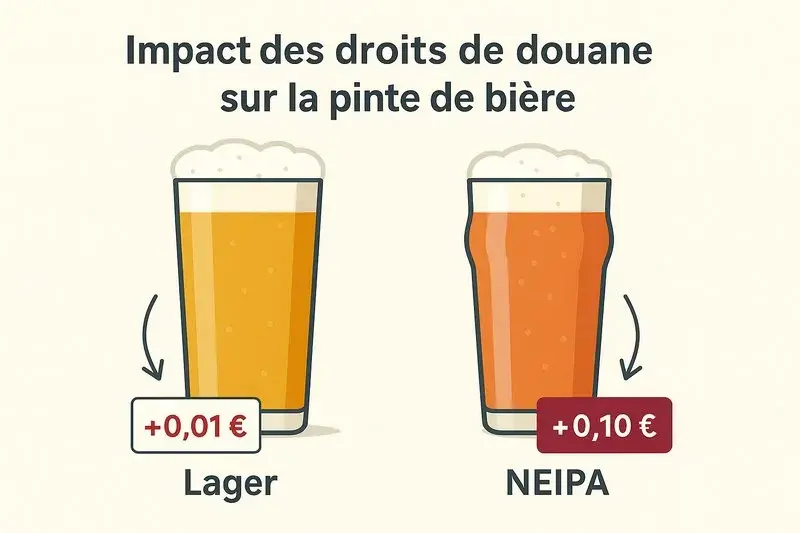
In the short term, if these measures came into force, the price of a pint of beer could rise, but not all beers would be affected equally: the increase would be 0.5 to 1 euro cents for a pint (50cl) of lager, but 8 to 10 euro cents for a pint of NEIPA (New England IPA).
Hop-forward styles (IPA, NEIPA) are more affected, as much because they use more hops (5 to 12 g per litre vs 1 to 2 g per litre for a lager) as because they use specific varieties grown in the USA, often protected by patents that prevent their cultivation in Europe: the famous Citra©, Amarillo™, Simcoe® and Mosaic®.
As for the varieties used in lagers or “blonde beers” (Tradition, Perle, Spalter, Strisselspalt, Fuggle), they are mostly produced in Europe.
But many American varieties, reputed to be fruitier, are in fact already produced in France and in Europe. In a 2023 consultation, Agence Bio stated that of the 10 varieties most used by brewers, 5 are produced in France and 7 in Europe, including Cascade, Chinook, Nugget, Centennial and Brewer’s Gold.
Importers and craft breweries on the front line
This increase in customs duties could hit hop-importing companies in Europe hard, such as Yakima Chief Hops, which has been based in a giant warehouse in Belgium since 2021 and generated 83 million in turnover in its first year there. This company, formed by the merger of the 11 largest American hop producers (9,510 hectares of hops, no less), has already had setbacks in early 2025: the entire 2024 organic hop harvest had to be blocked because of pesticide residues above the European limit, causing supply shortages for brewers.
Consequences vary by country
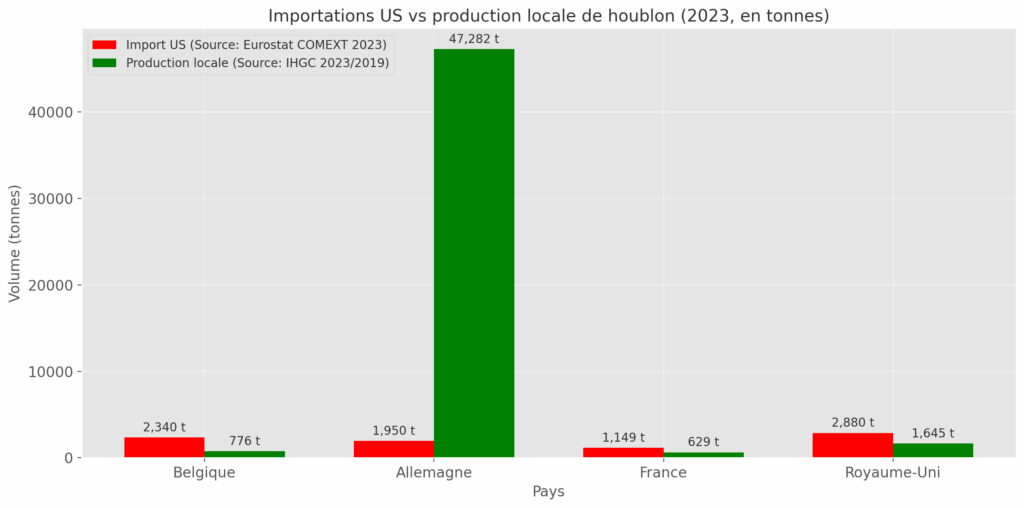
A surtax on US hops would weigh mostly on Belgium, which imports almost all of its hops and produces only a fraction of its needs. Germany, on the other hand, Europe’s leading hop producer and the world’s second, produces far more hops than it consumes and could easily compensate with its national production. France, with half of its volumes covered locally, could partly absorb the increase by relying on its local supply chains, which are more dynamic than in the rest of Europe. The United Kingdom, close to France on this point, would have to adjust its sources (Eastern Europe, local varieties) or give up certain styles. In every case, craft brewers in the most dependent countries are likely to raise their prices, while well-established or diversified supply chains will be best placed to limit the shock wave.
American hop crisis: an opportunity to relocalise supplies.
While the impact of these customs duties can be significant for breweries that have become dependent on American imports and a globalised supply chain, it may be more moderate, even nil, for those that have strengthened the robustness of their supply chain by favouring more local hops.
Olivier Malcurat and Théodore Bécquart discussed this in the Podcast : “Organic American hop crisis: what solutions for European breweries?”
“It’s a real question of sovereignty, it’s the global issue today”
“We should put the ingredients we have locally into our beers. We should start from a constraint in order to innovate, rather than innovate by taking inspiration from what is done elsewhere, which starts from a good idea but shows its limits today”
Théodore BECQUART
Despite the immediate difficulties, this crisis is also an opportunity to strengthen the sovereignty of the French brewing sector. While hop acreage in the United States is falling sharply (-38.7% in organic acreage between 2022 and 2024 and -26% in total acreage between 2021 and 2024), local European supply chains, and French ones in particular, are growing rapidly, with a +65% increase in total acreage in France in 2023 vs 2013, including 204 hectares grown organically, a sharp increase (vs 12 ha in 2013, i.e. +1,500%!)
Regional cooperation
This strengthening of local supply chains can be seen in Hauts-de-France, where several growers are organising to pool certain activities, and platforms such as brewstock.fr are emerging to make direct brewer ↔ grower access easier. The aim: to secure volumes, stabilise prices and offer aromatic profiles rooted in their terroir.
A surtax on US hops, if applied, could push up the price of a pint, especially for heavily hopped styles. But it is also an opportunity: to develop local production, diversify European varieties and make the sector more resilient.